

I’ve seen more teams destroyed by avoidance than by conflict.
When one of your people is not performing and no one says anything, the whole team will notice it. It quietly tells everyone that the standards don’t matter, and that is both a culture problem and a leadership problem. This is why avoiding hard conversations kills trust faster than the conflict itself ever could.
Let me share with you how I learned that.
Early in my career, I was serving in a squadron under an operations director. He was one of the leaders I reported to.
I went to him and asked for honest feedback on my own performance. I wanted to get better, so I asked him straight, “Where can I improve?”
He didn’t say a word, as if he didn’t care.
He was avoiding me, plain and simple, and he didn’t want to have the hard conversation.
And yes, I trusted him even less as a leader because of his lack of willingness to have hard conversations, among other things he had done that were not in alignment with good leadership.
Accountability Is an Act of Trust, Not the Opposite of It
A lot of leaders, who haven’t developed their leadership, take this wrong.
Accountability is an expression of trust. It is not the opposite of it. Man, I can’t stress this enough for leaders.
When you hold someone accountable, you’re telling them you believe they’re capable of being better. When you stay quiet, you’re telling them you don’t think they can handle it, or simply that you don’t care.
And the hard conversation most leaders avoid isn’t the one where someone gets fired. It’s the conversations that come well before that. The early, honest, direct ones, the ones that happen while there’s still time for someone to actually improve.
How to Have a Hard Conversation, in 3 Parts
When you sit down for one of these hard conversations, it really comes down to three things:
→ Here’s what I’m seeing. Name the specific behavior, not the person.
→ Here’s how you can improve, and the impact it’s having on the team.
→ Here’s where I need you to step up, and the level I need you to perform at.
When those conversations are done with care, they build character. They build accountability. They build trust.
When you avoid them, that is exactly where trust breaks down.
Because the teams that trust their leaders the most aren’t the ones where everything went smoothly. They’re the ones where the honest conversations happened early, and with care.
That’s the whole point. A hard conversation is really an act of care. It’s how you say, “I see you, I believe in you, and I respect you too much to pretend this is fine.”
Signs You’re Avoiding a Hard Conversation
Avoidance rarely feels like avoidance while you’re doing it. It feels like being busy, being patient, or giving someone the benefit of the doubt. Watch for:
- You’ve mentioned the same problem to yourself three or four times, but never to the person
- You find reasons to shorten or skip the one-on-one where you know it should come up
- You’re managing around the issue instead of addressing it, reassigning work quietly rather than naming the gap
- You’ve started rehearsing the conversation in your head, which means part of you already knows it’s overdue
- You catch yourself hoping the problem resolves on its own, or that the person figures it out without being told
If two or more of these sound familiar, you already know which conversation you’re avoiding. That’s the moment to remember that avoiding hard conversations kills trust far more slowly, and far more completely, than the conversation itself ever would.
Your Task This Week
Is there a conversation you’ve been putting off? You already know what it is. I promise you, the longer you wait, the more it’s going to cost you. Have it this week.
Blue Skies, Fair Winds, and All The Best,
Jason
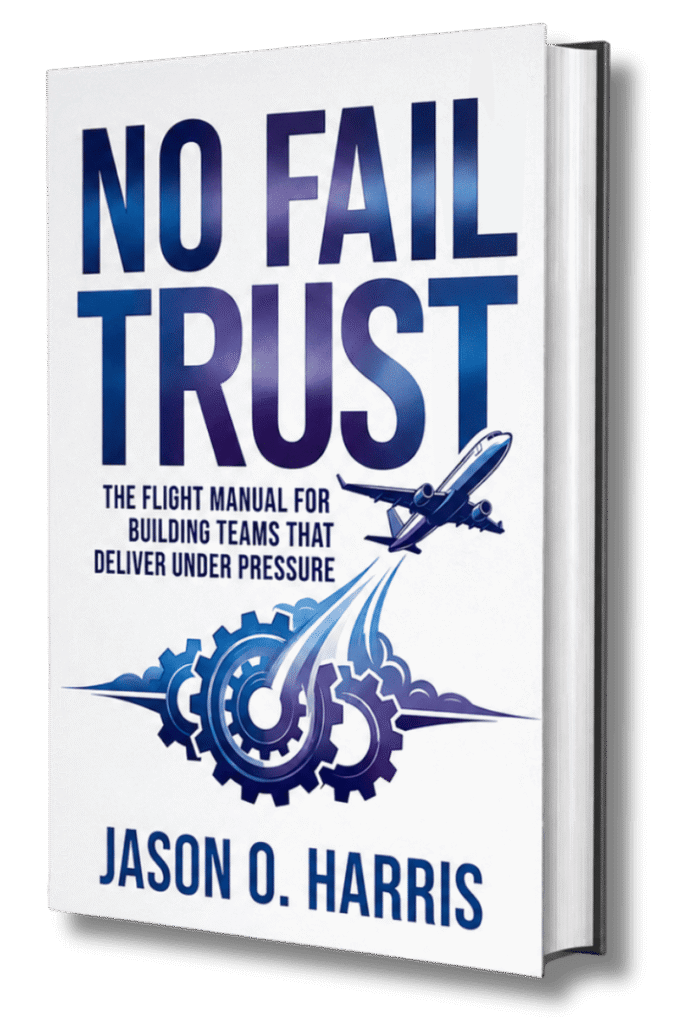
P.S. Every hard conversation you dodge is a quiet withdrawal from your team’s trust. No Fail Trust, my new book, shares insights and lessons on how you stop the leak and build a team that runs on commitment instead of compliance. It launches August 25, and pre-orders are open now.








 No Fail Trust Flight Companion Guide